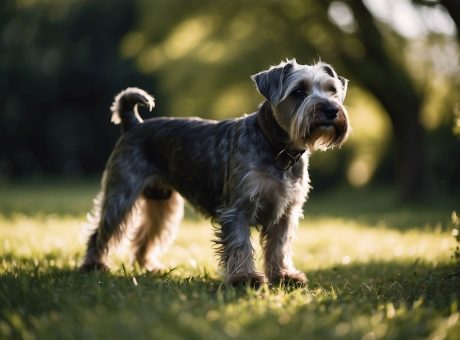
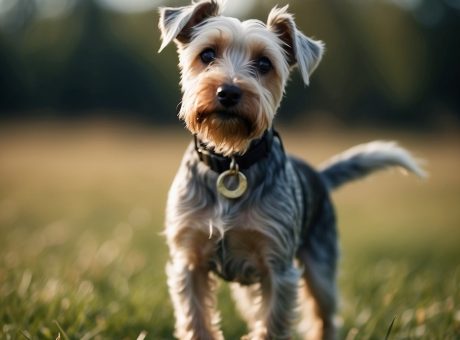
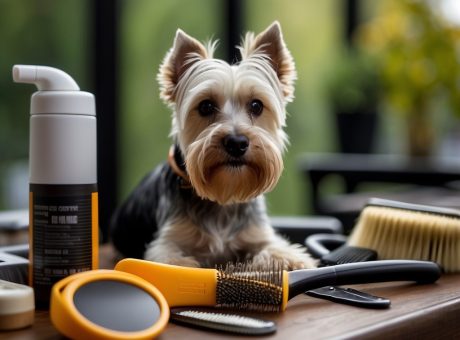
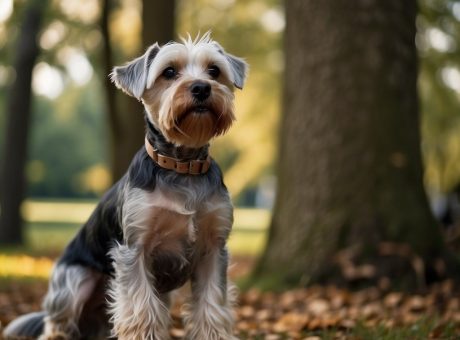
General Appearance
The Cesky Terrier was established in 1943 as the result of a planned breeding between a Scottish Terrier and a Sealyham
Terrier. The purpose was to develop a well-muscled, short legges and well-pigmented hunting terrier that could be worked in
packs. The Cesky Terrier has natural drop ears and a natural tail.
The Cesky is longer than it is tall and has a topline that rises slightly higher
over the loin and rump. It sports a soft, long, silky coat in shades of gray from Charcoal to Platinum.
The correct coat is clipped to emphasize a slim impression. The hallmarks of the breed should be unique unto itself with a
lean body and graceful movement. They are not to be mistaken for a gray specimen of the heavier boned parent breeds. They
are reserved towards strangers, loyal to their owners, but ever keen and alert during the hunt.
Size, Proportion Substance
Ideal Measurements
Height – Height at withers
10 - 13 inches.
Weight – Weight is ideally between 16 and 22 pounds, bitches slightly less, (suggested to be no less
than 14 pounds and no more than 24 pounds) however, no Cesky in good condition and otherwise well balanced shall be penalized
for being only slightly outside the suggested weight.
Length – The length of body, measured
from sternum to buttocks ideally between 15 and 17 inches. To be in
a ratio of approximately 1 1/2 (Length) to 1 (Height). The overall balance is more important than any single
specification.
Girth of thorax (behind elbows) – The girth of the body measured at the thorax, behind the
elbows ideally is 17 to 18 inches.
Head
Head – Head is about 7 to 8 inches long, 3 to 4 inches wide and is shaped like a long, blunt wedge. The plane
of the forehead forms a slight but definite stop with the bridge of the nose.
The breadth between the ears is slightly larger for a dog than a bitch. The head should join the neck smoothly.
Eyes - Almond shaped of medium size. Slightly deep
set with a friendly expression. Brown or dark brown in
gray dogs; light brown in brown dogs.
Ears - Medium size, dropping in such a way to well cover the orifice. Ears are set rather high with forward
edge lying close to the cheek. Shaped like a triangle, with the shorter side of the triangle at the fold
of the ear.
Skull – Skull is shaped like a blunt wedge with the broadest part between the ears which tapers moderately towards the supraorbital
ridges. Occipital protuberance easy to palpate, cheek bones moderately prominent.
Frontal furrow only slightly marked. A shallow indentation running down the brows, and joining the muzzle with a moderate
stop.
Muzzle - Nasal Bridge straight. Narrow foreface undesirable.
Stop – Not accentuated but apparent.
Nose – Dark and well developed.
Black in gray dogs and liver colored in brown dogs.
Teeth – Set square in
a strong jaw, sound and regular, and of good size. Either scissor or level bite is expectable.
Complete dentition preferred.
Neck,
Topline and Body
Neck – Well
muscled and strong. Medium-long, carried in a slight arch. Set firmly on the shoulders.
Topline – Not straight
but with a slight rise over the loin and rump.
Body –
Fully muscled, longer than high. Withers
not very pronounced with the neck set rather high. Rump is strongly developed, muscular; pelvis moderately
slanting with the hip bones often slightly higher than the withers.
Belly
– Ample and slightly tucked up. Flanks well
fitted.
Chest – More
cylindrical than deep.
Ribs – Well sprung.
Loins
– Relatively long, muscular, broad and slightly
rounded.
Tail – The
ideal length is 7 to 8 inches. Set following the line of the rump. Tail may be carried downward or with a slight bend at tip; or carried saber shaped horizontally or higher. All
of these tail carriages are considered correct with none having preference over the other. Curled squirrel
tail penalized.
Forequarters
Shoulder – Muscular,
well laid back and powerful.
Elbows
– Should fit closely to
the sides and be neither loose or tight.
Forelegs
– Short, straight, well boned and parallel.
Dewclaws may be present.
Forefeet – Large, well-arched toes with strong nails and well-developed pads.
Hindquarters
Hindlegs – Strong,
well-muscled and longer than the forelegs.
Thigh - Longer in proportion to the lower leg with stifle well bent.
Hock Joint - Strong and well
developed. Well let down and parallel to each other. Lower leg is straight from hock
to heel.
Hindfeet – As
front but smaller.
Coat
Long, fine but slight texture. Furnishings slightly wavy
with a silky gloss. Shorter hair can have more curl. Not overdone with too much
furnishings.
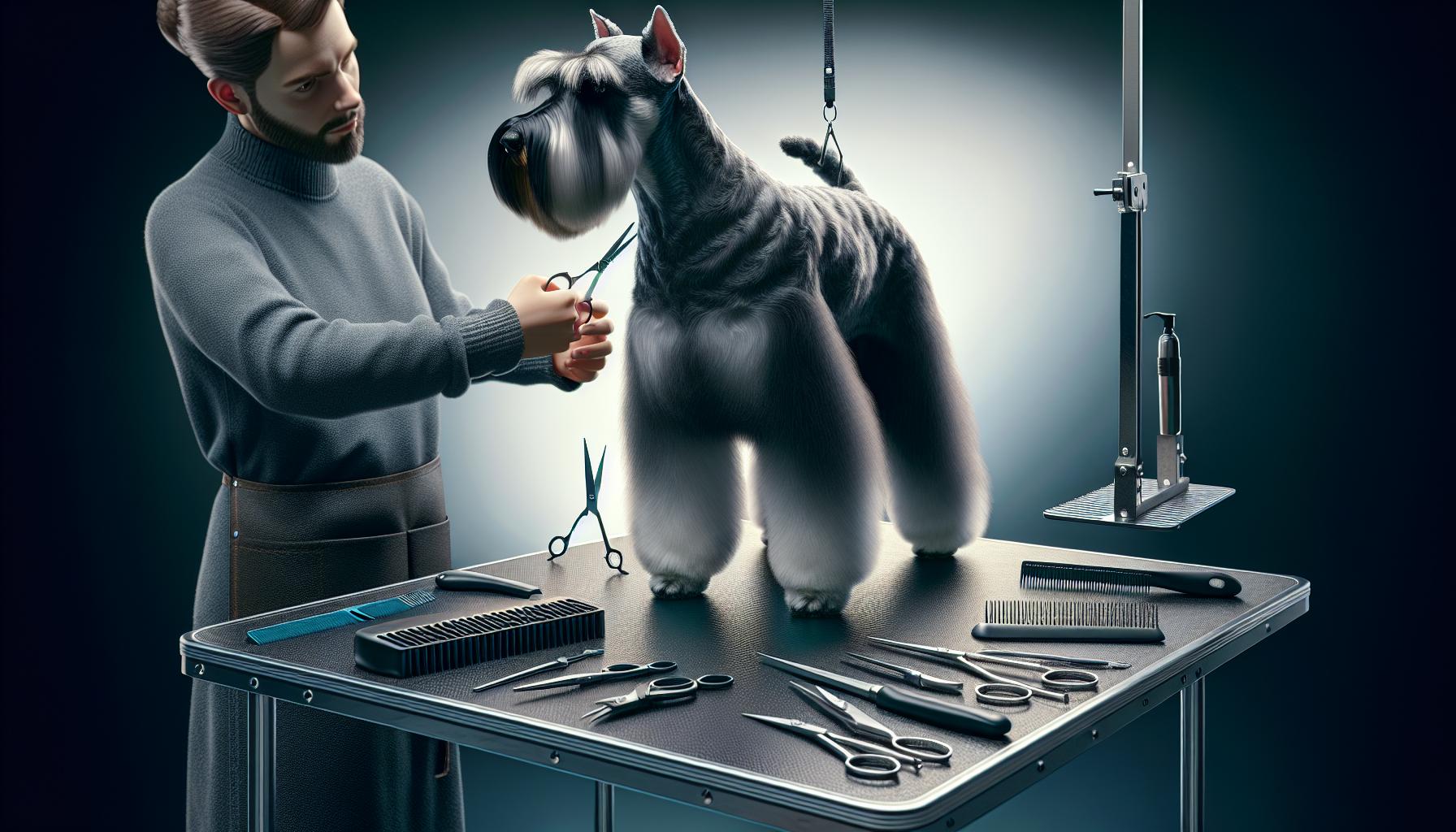
Clipping for presentation:
Head and neck: On the foreface, the hair is not to be trimmed except for cleaning
up long hair to form a beard and eyebrows. The eyebrows should angle from the outside corner of the eye and work into the
fall that is left long between the eyes. The beard is trimmed at an angle from the underside of the eye to the corner of the
mouth and around the lower jaw. The hair on the cheeks and underside of the neck is clipped quite short, ¼ inch long.
The hair on the upper side of the neck is trimmed to about ½ to 1 inch long.
Chest and Forequarters: The short hair on the
underside of the neck is continued down the chest. Long furnishings begin at the level of where the front leg couples with
the body and continue across the front of the dog in a straight line that is not blended into the short hair of the upper
chest and neck. The short hair is continues over the shoulder muscles and stops where the body ties into the forequarters
of the dog. The top lateral portion of the front leg is also clipped short in a U shape as to show off the powerful muscle
of the upper leg. The rest of the hair on the front leg is grown out in long furnishings that stop at ground level.
Body: The hair on the body is clipped to ½
to 1 inch to form a saddle starting at the withers and ending in a V shape on the tail. The longer hair on the back is blended
into shorter ¼ to ½ inch hair which covers the sides of the dog. Long furnishings start at the level of the
elbow and continue across the lower portion of the ribcage to the tuck-up.
Hindquarters: The hair covering the heavy muscling
of the thigh from the point of the hipbone to the top of the hock is clipped short, ¼ inch. Long furnishings start
at the tuck-up run down the front of the hind leg and across to the hock. The furnishings continue down from the hock to ground
level. The hair covering the vent and tail is clipped short 1/8 to ¼ inch except for a V shape of longer hair from
the back saddle worked into the very top part of the tail where it meets the body.
Overall Appearance: The transition between clipped
and unclipped areas should be pleasing to the eye and never abrupt. The overall trimming is done with electric clippers and
finished with shears. The final haircut should show off the strong, muscled Cesky Terrier.
Color
All puppies are
born black, black and tan, or brown **see footnote** The correct mature color in dogs 2 to 3 years old
is any shade of gray from dark charcoal to platinum gray. Black may appear on the head, ears, feet and tail. White, brown
and yellow markings are permitted on the head, beard, cheeks, neck chest, limbs and around the vent. A
white collar or white tip is permitted on the tail. The base color must always be predominant.
** There
has been no Brown Cesky Terrier born since a litter in 1952. This color is still in the standard but yet to be repeated in
modern breeding.
Gait
The action should be free and even, with good reach in both the front and back, covering the ground effortlessly.
This is a working terrier, which must have agility, freedom of movement and endurance to work.
Temperament
Balanced, non-aggressive. Not to be sparred in the show ring. Can be reserved toward
strangers. A pleasant dog that is not as excitable as other terrier breeds but always ready to give chase to something of
interest. When working they can be silent but right on target and also able to work underground in burrows and scent track
game.
Faults
(Approved by AKC May 2007)
(Approved by ACTFA
June 2007)